

Request-to-Exit Devices: Push Buttons, PIR Sensors and Touchless Options
Essential Security Supplies
Choosing the right request-to-exit device is an important part of designing a reliable access control system. Although the job may appear simple — signal the system when somebody wants to leave — the best device depends on the door, traffic level, security requirements, accessibility needs and the way the access control system is configured.
For New Zealand installers, the most common options are push-to-exit buttons, PIR request-to-exit sensors and touchless exit devices. Each approach has advantages, but they are not automatically interchangeable.
This guide explains how the three technologies work, where each is best suited and what installers should check before specifying a request-to-exit solution.
What Is a Request-to-Exit Device?
A request-to-exit device — commonly shortened to REX or RTE — tells an access control system that a person on the secure side of a controlled door intends to leave.
Depending on the system design, the REX signal may be used to:
- trigger an access controller input;
- release an electrically controlled lock;
- temporarily shunt a door alarm;
- prevent a valid exit from being recorded as a forced-door event; or
- start a programmed door-release or door-held-open timer.
This makes the REX device part of the complete door-control design rather than simply an accessory mounted beside the door.
Installers can view the complete Request-to-Exit range available from Essential Security Supplies.
Option 1: Push-to-Exit Buttons
A physical push button is still one of the most straightforward ways to provide request-to-exit operation. The user deliberately presses the button, which produces a clear electrical signal to the controller or associated door-release circuit.
This deliberate action is one of the main advantages of a push button. Unlike an automatic detector, it generally does not activate simply because somebody walks past the door.
Where Push Buttons Work Well
Push buttons are commonly appropriate for:
- commercial offices;
- staff-only doors;
- warehouses and industrial premises;
- controlled internal doors;
- doors where deliberate exit activation is preferred; and
- installations where a simple and easily understood user interface is required.
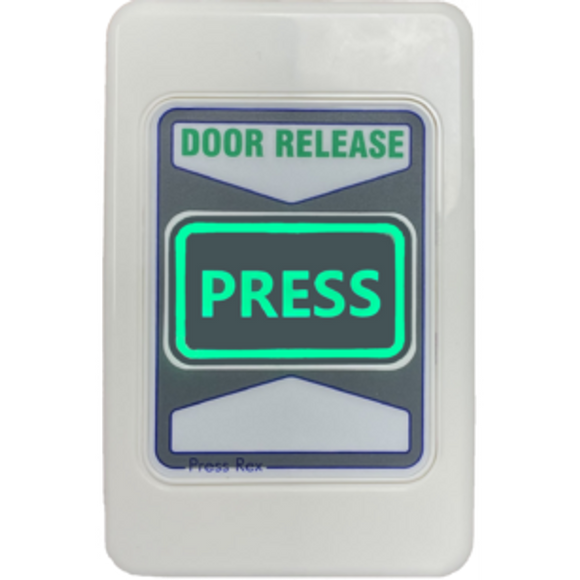
Trojan Press-Rex provides a clearly identifiable illuminated push-to-exit control for access-controlled doors. View Trojan Press-Rex specifications and product details.
Advantages of Push-to-Exit Buttons
- Intentional activation: the user must physically operate the button.
- Simple operation: users immediately understand how to exit.
- Predictable detection area: there is no motion-detection zone to configure.
- Easy troubleshooting: operation can generally be tested directly at the door.
- Wide selection: flush, surface-mount, illuminated and more robust options are available.
Potential Limitations
The main disadvantage is physical contact. In high-traffic locations, conventional mechanical buttons can receive considerable use, and touch-free operation may be preferable in some environments.
Button position also needs careful consideration so the control is obvious, accessible and convenient without being vulnerable to accidental activation.
Option 2: PIR Request-to-Exit Sensors
A PIR request-to-exit sensor detects movement within a defined area on the secure side of the door. When a person approaches the exit, the detector can generate the REX signal automatically.
This allows users to leave without locating or physically touching a button.
Dedicated REX PIRs should not be confused with ordinary burglar-alarm PIR detectors. Products designed specifically for egress applications may include door-control relay outputs, adjustable timing, detection-zone configuration and other functions intended for access-controlled doors.

The RISCO iREX Plus is a dedicated PIR request-to-exit detector intended for access-control applications. View RISCO iREX Plus specifications and product details.
Where PIR REX Sensors Work Well
- busy commercial entrances;
- doors where hands-free exit is desirable;
- staff carrying equipment or stock;
- doors with consistent pedestrian approach paths; and
- locations where users should not need to stop and press a button.
The Detection Zone Matters
One of the most important considerations with a PIR REX sensor is where it detects movement.
If the detection area is too broad, people moving near the door without intending to leave may generate unnecessary REX signals. If it is too narrow, somebody approaching from an unusual direction may not be detected early enough.
Before completing an installation, test the door from the actual approach paths users will take — not simply by waving a hand underneath the detector.
Security Considerations
The effect of an unwanted PIR activation depends heavily on how the REX input and locking hardware are configured.
- whether REX merely shunts door monitoring or directly releases the lock;
- the presence of nearby glazing or reflective surfaces, noting that conventional PIR sensors generally do not detect motion through ordinary glass;
- the distance between the detector and the door;
- traffic moving across the detection area;
- controller REX timing;
- door contact monitoring; and
- the security level required at the opening.
For higher-security applications, REX detection should be considered as part of the complete locking, monitoring and controller architecture. For the related inputs and alarm sequence, see our door monitoring, REX and forced-door alarm guide.
Option 3: Touchless Request-to-Exit Devices
Touchless exit devices sit between a conventional push button and an automatic PIR detector.
The user deliberately presents a hand or finger near the device, providing intentional activation without requiring the conventional mechanical action associated with a standard push button.
This makes touchless technology particularly useful where hygiene, accessibility or reduced mechanical wear is important.
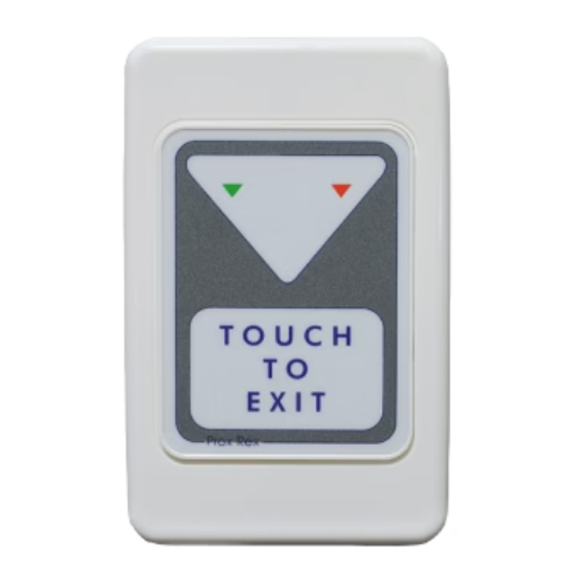
Trojan Prox-Rex provides deliberate electronic exit activation without a conventional mechanical push button. View Trojan Prox-Rex specifications and product details.
Where Touchless Exit Devices Work Well
- healthcare environments;
- high-use commercial doors;
- public facilities;
- accessible entrances;
- clean environments;
- food preparation or processing areas; and
- sites seeking to reduce contact with shared surfaces.
Touchless Does Not Necessarily Mean Automatic
This distinction is important. A PIR detector normally detects a person approaching the door automatically. A near-field touchless device generally still requires a deliberate action from the user.
That can make touchless REX particularly attractive where installers want the reduced-contact benefits of electronic activation without creating a large automatic detection zone around the doorway.
Push Button vs PIR vs Touchless REX
Use this comparison to shortlist the appropriate exit control, then confirm the controller input, lock operation and any separate emergency-egress requirements before installation.
| Consideration | Push Button | PIR Sensor | Touchless Device |
|---|---|---|---|
| User action | Physical press | Normally automatic | Deliberate hand/finger activation |
| Physical contact | Yes | No | Minimal or none depending on device |
| Accidental activation risk | Low when positioned correctly | Depends strongly on detection zone | Generally low with correct positioning |
| Hands-free exit | No | Yes | Near-touch / deliberate gesture |
| Best suited to | Simple deliberate exit control | Automatic high-flow egress | High-use and low-contact applications |
Compare the devices: Trojan Press-Rex push button, RISCO iREX Plus PIR sensor and Trojan Prox-Rex touchless device. For other options, browse the full request-to-exit range.
Do Not Confuse REX With Emergency Egress
A normal request-to-exit device and an emergency door-release device do not necessarily perform the same function.
A push button, PIR or touchless REX commonly provides a signal used by the access control system during normal operation. Emergency release arrangements may need to operate differently depending on the lock type, door hardware, building design, fire requirements and applicable New Zealand regulations.
Where emergency egress is required, the complete door system should therefore be designed around the applicable requirements rather than assuming the normal REX device provides the required emergency release function. Verify the door's approved fire and evacuation design and the applicable New Zealand Building Code requirements with the project's qualified designer.
Check the Locking Method Before Selecting REX
The type of lock fitted to the door affects how the entire exit sequence should work.
Common access-controlled locking products include electromagnetic locks, electric strikes, electric mortice locks, drop bolts and other electromechanical locking hardware.
An installer should establish exactly what the REX output is expected to control before wiring the device.
Browse the access control locking range or read our guide to how door access control works for more information about how the controller, reader, lock, door contact and REX device work together.
NO, NC and Relay Outputs
Another detail that installers should check before ordering is the output configuration.
REX devices may provide normally open, normally closed or changeover relay contacts. Powered electronic devices may also require a separate supply. Before connecting a device, confirm:
- the REX input type required by the controller;
- the device supply voltage;
- relay contact ratings;
- whether a dry-contact output is required;
- whether the input is supervised;
- the desired unlock or shunt time; and
- how the controller should respond if the device or wiring fails.
Mounting Position Is Part of the Design
Good REX performance depends on more than the product itself.
A push or touchless device should be positioned where users naturally look for an exit control. A PIR detector must be located so its coverage captures genuine exit movement without unnecessarily detecting unrelated activity around the door. Check the following site conditions:
- door swing;
- nearby corridors;
- glass panels;
- accessible mounting requirements;
- surface versus flush mounting;
- cable entry;
- environmental exposure; and
- the possibility of accidental or malicious activation.
Which Request-to-Exit Device Should You Choose?
There is no single REX technology that suits every door.
Choose a push button when deliberate activation, simplicity and predictable operation are the priorities.
Choose a PIR REX sensor when automatic hands-free egress is desirable and the detection zone can be carefully controlled.
Choose a touchless exit device when deliberate activation is still wanted but reducing physical contact and mechanical wear is important.
For more complex installations, the strongest solution may combine REX operation with door contacts, access-controller logic, monitored locking and separate emergency egress hardware.
Request-to-Exit Products for New Zealand Installers
Essential Security Supplies stocks a broad range of request-to-exit devices, including push buttons, PIR detection devices, touchless exit controls and associated access-control hardware.
When specifying a device, consider the entire opening — not only the REX unit. Lock type, controller operation, door monitoring, traffic flow, accessibility, mounting position and emergency-egress requirements should all be considered together.
Need help selecting a request-to-exit device for a project? Contact Essential Security Supplies with the door type, locking hardware and access-control system being used and our team can help identify suitable options. You can also browse our request-to-exit product range.
Technical Reference
For manufacturer specifications and installation information for the PIR option discussed above, see the official RISCO iREX Plus product information.
Subscribe to Media Posts
Recent Articles


